 FocusPod Solo™
 FocusPod Solo Plus™
 FocusPod Duo™
 FocusPod Team™
 FocusPod Meet™
 FocusPod Max™
Buyers guide
How to buy an office pod without overpaying.
What to compare, what the numbers mean, and the questions that separate a real supplier from a reseller with a catalogue.
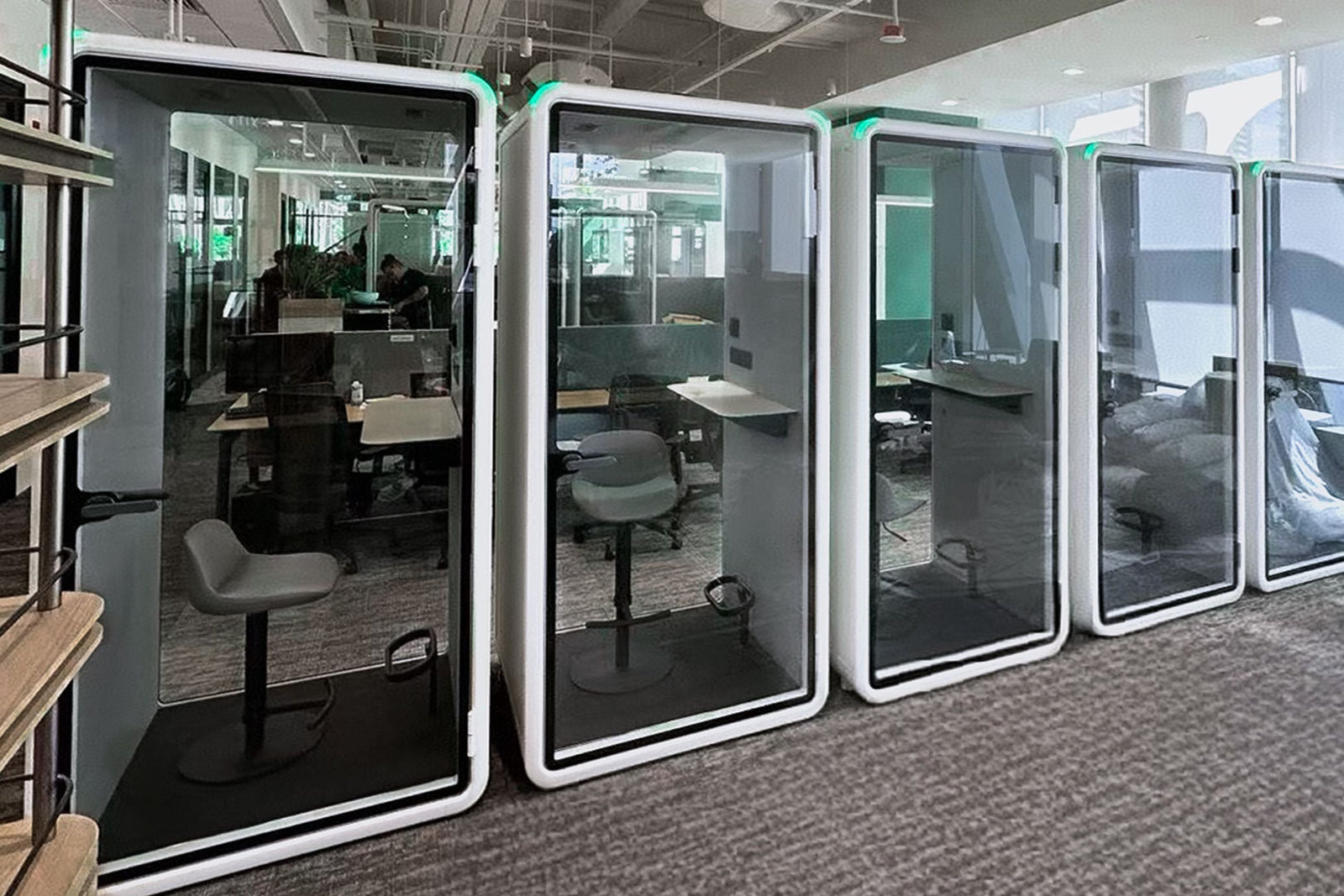
Buying an acoustic office pod in Australia comes down to six things: the size that fits your floor, a Class A speech reduction rating tested to ISO 23351, ventilation with a stated air change rate, Australian electrical compliance, stock held locally rather than a 12 to 16 week import, and a price broken into pod, delivery, installation and furniture as separate lines. Expect $7,595 to $14,995 ex GST for the pod itself.
First, the honest framing
Written by a supplierWe sell these, so read this accordingly. What follows is the same advice we give on the phone, including the parts that cost us margin — that a Solo is usually the right answer over a Solo Plus, that screens are cheaper if your problem is visual distraction rather than noise, and that hiring beats buying under six months.
The reason for being straight about it is simple. Most of what is published about office pods is written by people who have never installed one, and the specification claims in this category are close to unregulated. If you finish this page able to interrogate any supplier's quote, including ours, we are happy.
1. Get the size right
The expensive mistakeSize is where most of the money is won or lost, and the mistake runs in both directions. Buying one size down to save $3,000 gets you a pod used for the wrong thing. Buying a large square pod when a narrow one would have fitted costs you floor space you cannot get back.
Match the shape to the wall, not just the headcount. A 2300 × 966 mm pod fits flat against a wall run or window line. A 2300 × 1785 mm pod needs a corner or an island position and eats circulation space. Both seat similar numbers.
| Model | Solo | Solo Plus | Duo | Team | Meet | Max |
|---|---|---|---|---|---|---|
| Capacity | 1 person | 1 person | 2 people | 2 people | 4 people | 6 people |
| Exterior W×D×H | 1080 × 1000 × 2338 mm | 1600 × 1375 × 2338 mm | 1600 × 1375 × 2338 mm | 2300 × 966 × 2338 mm | 2300 × 1785 × 2338 mm | 2600 × 2605 × 2338 mm |
| Interior W×D×H | 942 × 960 × 2146 mm | 1462 × 1335 × 2146 mm | 1462 × 1335 × 2146 mm | 2162 × 926 × 2146 mm | 2162 × 1745 × 2146 mm | 2462 × 2565 × 2146 mm |
| Floor space | ~1.0 m² | ~2.2 m² | ~2.2 m² | ~2.2 m² | ~4.1 m² | ~6.77 m² |
| Net / packed weight | 290 / 335 kg | 442 / 502 kg | 442 / 502 kg | 504 / 564 kg | 635 / 700 kg | 852 / 970 kg |
| Ventilation | 0–70 m³/h | 0–110 m³/h | 0–110 m³/h | 0–110 m³/h | 0–218 m³/h | 0–327 m³/h |
| Air change | ~1.6 min | ~2.3 min | ~2.3 min | ~2.3 min | ~2.2 min | ~2.4 min |
| Power draw | 40 W | 52 W | 52 W | 60 W | 100 W | 120 W |
| Price from | $7,595ex GST, delivered | $10,595ex GST, delivered | $10,695ex GST, delivered | $11,695ex GST, delivered | $12,995ex GST, delivered | $14,995ex GST, delivered |
Dimensions are exterior, width × depth × height. Interior heights are 2146 mm across the range, so ceiling clearance is the same question whichever model you choose.
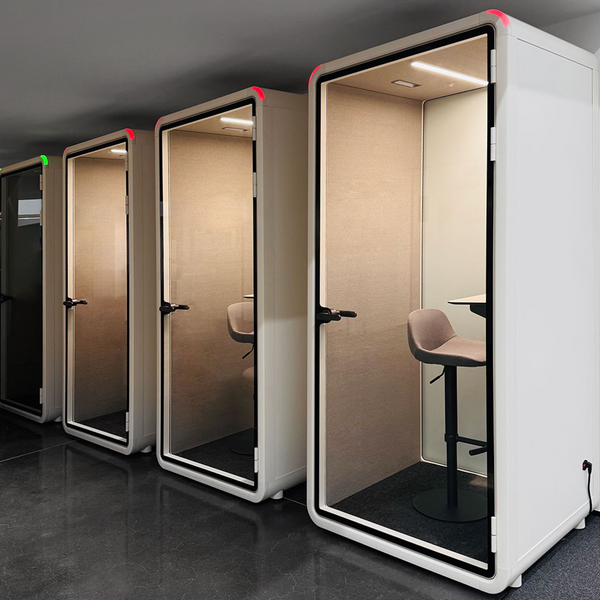
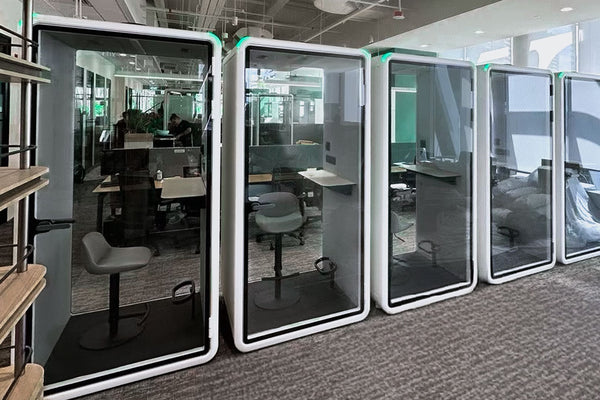
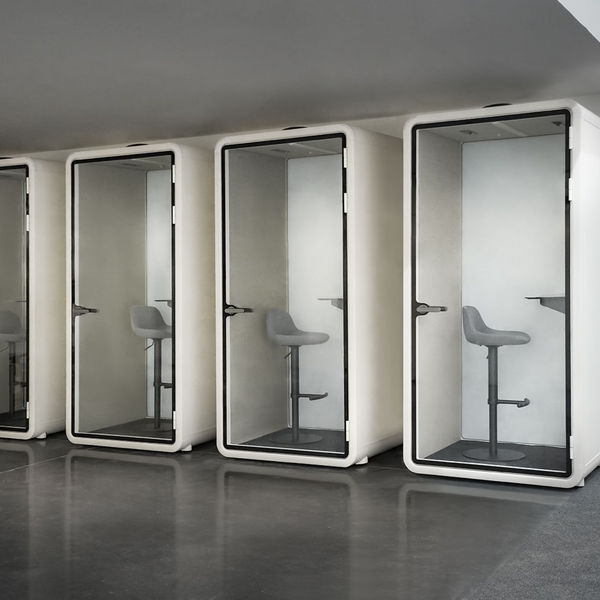
What they look like on a real floor
Not renders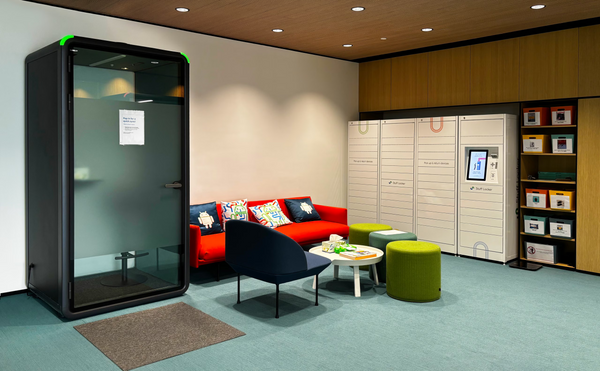
2. Read the acoustic claim properly
ISO 23351-1Ask for the standard and the report number, not the decibel figure. Speech level reduction in booths is measured under ISO 23351-1:2020, which sorts results into classes. Class A is the highest.
A supplier quoting "up to 35 dB" with nothing behind it is quoting a number from a brochure. The measurement conditions matter enormously — a figure taken at one frequency, or on a sealed sample rather than a built booth with a door in it, is not comparable to a Class A result.
Two other things worth knowing. Nothing is soundproof, and any supplier using that word without qualification is overselling. And the door decides more than the wall does: panel density is easy to specify and hard to check, but a poorly sealed door is audible from the first day.

The door and its seal
Ask to see the door closed and listen from a metre away. Panel density is easy to claim and hard to verify. A door seal is audible on day one and it is where cheap booths give themselves away.

Where the air actually goes
Ask to see the intake and the outlet. A booth with a single fan and no considered path moves air around rather than through, which is why it feels stuffy despite the spec sheet.
3. Ventilation is what decides whether it gets used
Ask for m³/hThis is the most under-asked question in the category, and the reason perfectly good pods sit empty. A booth with weak airflow becomes uncomfortable within twenty minutes, people notice, and after two bad experiences they go back to taking calls at their desk.
Ask for the airflow in cubic metres per hour and the air change interval. As a reference point, a one-person booth moving up to 70 m³/h changes its air roughly every 1.6 minutes, and a six-person pod at 327 m³/h every 2.4 minutes.
Also ask what happens when nobody is inside. A pod that only ventilates when occupied is stale when the next person opens the door. Ours runs a five-minute exchange every thirty minutes of vacancy for exactly this reason.
4. Australian electrical compliance
AS/NZS 3000A pod supplied for the Australian market plugs into a standard 240V 10A outlet, draws between 40 and 120 W, and needs no dedicated circuit, hard-wiring or electrician. Internal wiring should be to AS/NZS 3000, with a circuit breaker inside the pod.
Units imported directly from overseas marketplaces frequently arrive with US or EU outlets, which cannot legally be used here without rework. Retro-fitting Australian outlets to an imported booth is not a cheap afternoon. Confirm the outlets and the wiring standard in writing before ordering, whoever you buy from.
Net assembled weights range from 290 kg for Solo to 852 kg for Max. Packed weights include packaging and are listed separately. Ask your building manager or structural engineer to assess the pod, furniture and occupant loads and support locations against site-specific floor capacity.
5. Lead time is a cost, not a detail
Days or monthsTwelve to sixteen weeks is standard for pods built to order overseas. If your team needs quiet space before a move, an audit, a hiring intake or a lease event, a cheaper pod arriving in December is not cheaper.
Ask what is physically in Australia today, in what colours, and get the lead time in writing. Standard white and grey combinations usually ship within days. Custom colours are genuinely a four to six week build, and any supplier promising custom finishes overnight is telling you something else.
6. Make the price legible
Refuse bundled totalsThe single most useful thing you can do is insist every quote is broken into pod, freight, installation and furniture as separate lines. Bundled numbers are not comparable between suppliers, and that is usually the point of them.
For reference, here is what the lines look like across our range.
| Line | Solo | Solo Plus | Duo | Team | Meet | Max |
|---|---|---|---|---|---|---|
| Pod, delivered | $7,595 | $10,595 | $10,695 | $11,695 | $12,995 | $14,995 |
| Installation | $995 | $1,295 | $1,295 | $1,395 | $1,495 | $1,795 |
| Furniture (from) | $449 | $950 | $700 | $1,000 | $2,000 | $1,500 |
All ex GST. Delivery is included Australia-wide. Ask about multi-unit discounts — most suppliers hold one back for the second and third pod and will not offer it unprompted.
The questions to ask any supplier
Including usWhat standard is your acoustic rating measured to, and what is the report number?
Class A to ISO 23351-1 is the answer you want. A decibel figure alone is not an answer.
What is the airflow in m³/h, and does it ventilate when empty?
The second half of that question separates suppliers who have thought about real use from suppliers who have not.
Are the outlets Australian and is the wiring to AS/NZS 3000?
Get it in writing. This is where direct imports come unstuck.
What is in stock in Australia today, and in what colours?
Not what is orderable. What is on the floor.
What is the net weight and footprint?
Your building manager will ask, and a supplier who cannot answer immediately has not read their own spec sheet.
Where are spare parts held, and what is the warranty term?
Parts in Australia versus parts shipped from overseas is the difference between a two-day fix and a two-month one.
Can I see the quote as separate lines?
If the answer is no, that tells you what you need to know.
Where to go next
Keep readingThe full range and current pricing · One-person phone booths · Meeting pods for two to six · Pod versus building a meeting room · Hire instead of buying
Common questions
Asked by real buyersWhat should I look for when buying an office pod?
Six things: the right size for the floor space, a Class A speech level reduction result tested to ISO 23351 with a report number, a stated ventilation air change rate, Australian electrical compliance to AS/NZS 3000 with local outlets, stock held in Australia rather than a long import lead time, and an itemised quote that separates pod, delivery, installation and furniture.
How much should an office pod cost in Australia?
Between $7,595 and $14,995 ex GST for the pod, depending on size, with delivery included by a reputable supplier. Installation adds $995 to $1,795 ex GST and furniture from $449. If a quote is a single bundled number with no breakdown, ask for the lines.
What acoustic rating should an office pod have?
Look for Class A under ISO 23351-1, which is the highest band for speech level reduction. That corresponds to roughly 30 dB of reduction and means a normal speaking voice inside is not intelligible outside. A decibel figure quoted without naming the standard it was measured against tells you nothing.
How long should an office pod take to arrive?
Days, if the supplier holds Australian stock. Twelve to sixteen weeks is normal for pods built to order overseas, and that lead time is a real cost if you need quiet space before a lease event, an audit or a hiring intake.
Do office pods need building or council approval in Australia?
No, in almost all cases. A freestanding pod does not attach to the floor, walls or ceiling and is treated as furniture rather than building work. Your lease may still have conditions on floor loading, so check it and ask the supplier for the pod's net weight and footprint.
Will an office pod fit in my building's lift?
Usually, because pods ship flat-packed. Packed pallets are 1270 mm tall and between 570 and 1100 mm deep, but up to 2650 mm long, which is the dimension that catches people out. Measure the internal lift, the door width and any tight corners between the dock and the destination before ordering.
Is it better to buy or hire an office pod?
Hire for events and for anything up to about six months. Buy beyond that — cumulative rental starts overtaking the purchase price, and most suppliers worth dealing with will tell you so rather than take a long rental.
How many office pods does an office need?
One per fifteen people is a reasonable starting ratio for a team taking a normal amount of calls, and one per eight to ten for sales, recruitment or client-facing teams. Two together get used considerably more than one, because people stop trying after finding a single pod occupied twice.
The whole range, in five pages.
Every model side by side: dimensions inside and out, weights for floor loading, acoustic and air-quality testing, electrical, materials and finishes.
- All six models compared
- Net and packed weights
- Independent test references
- Options, furniture and lead times
Still comparing suppliers?
Send us the other quote. We will tell you honestly where it is better than ours and where it is missing something, and you can decide from there.